Sunset Color Checklist: 12 Signs of an Unforgettable Sky
Ten minutes before sunset, the sky either commits or holds back. You can usually tell which by looking west, and not at the sun. The light that paints an evening sky travels a long way through the atmosphere before it reaches the clouds above your head, and every detail along that path — cloud height, cloud thickness, the state of the air, the size of the gap between the cloud deck and the horizon — nudges the result toward brilliance or toward a soft gray shrug. What follows is a working checklist of the signs worth reading in the half hour before the sun goes down.
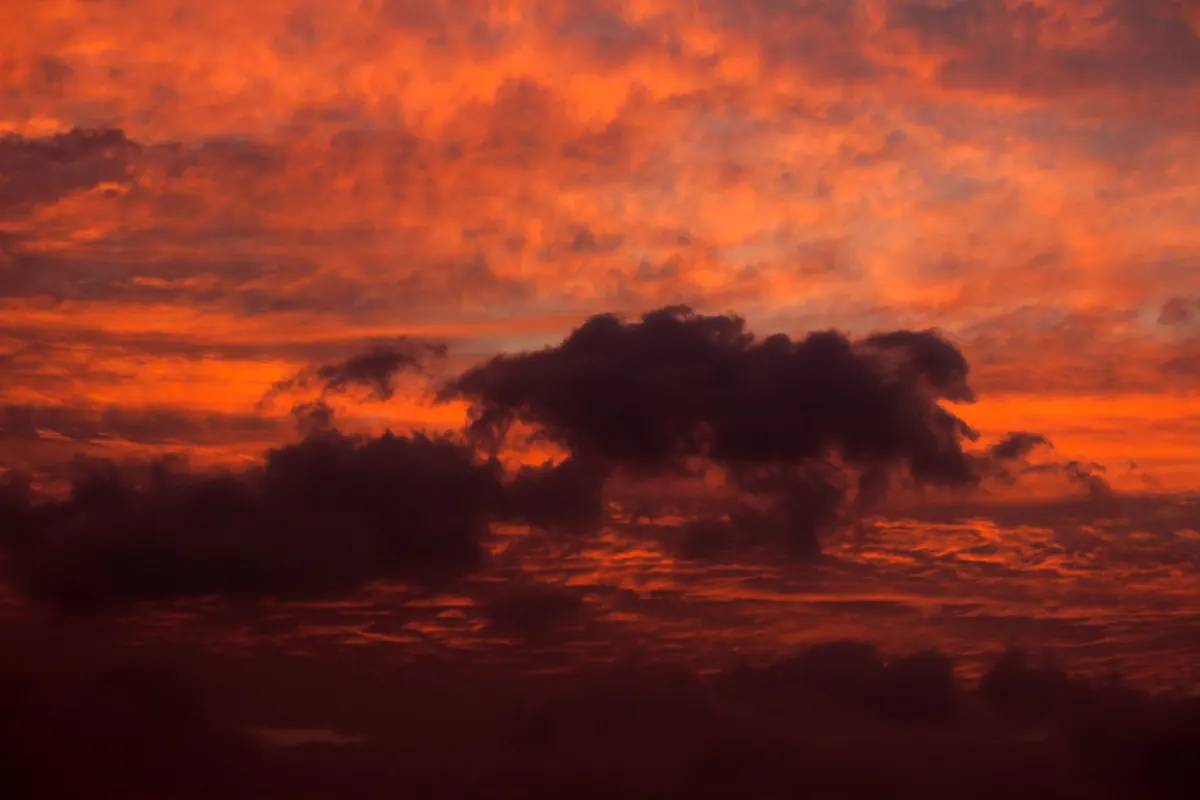
Low sunlight is the paint; clouds are the canvas. A perfectly clear evening gives you a smooth gradient of peach into blue, which is lovely but rarely dramatic. What creates the drama is a middle layer of cloud, sitting high enough to stay lit after the ground has gone dim, textured enough to break the light into shapes.
A solid stratus deck is the usual culprit behind a flat evening: uniform gray, no texture, no gaps, thick enough to swallow the sun before it ever reaches the horizon. Thick nimbostratus is worse. The other quiet failure is the opposite problem — a sky so empty that light has nothing to strike. If the only cloud in sight is a single thin streak overhead, expect a pleasant wash rather than a spectacle.
This is the detail most people miss, and it decides more sunsets than any other. For the underside of a cloud deck to light up, direct sunlight has to get underneath it. That requires a clear band of sky along the western horizon, something on the order of five to fifteen degrees tall — roughly half a fist to a full fist held at arm's length.
If the cloud sheet runs all the way down and touches the horizon line, the sun is extinguished behind it and the show ends early. If there is a clean gap, light pours through like a torch under a door and sets the whole ceiling glowing. Before you leave the house, find a vantage point with an open western view: a hilltop, a seafront, a long field, or a bridge above the rooftops. A gap you can see is worth more than a camera you can't.
Step outside and look at the distance. If far hills, towers or treelines are crisp and dark against the sky, the air is relatively clean and the colors will stay saturated rather than smeared. If the distance turns milky and pale, moisture or haze is scattering light before it reaches you, and even good clouds can produce a washed-out result.
Some haze helps. A little dust, smoke or fine aerosol deepens oranges and reds by filtering out the cooler wavelengths, which is why the evenings after a hot, still, dusty day can be extraordinary. The trouble is heavy humidity with no wind: everything goes soft, the horizon loses its edge, and shadows fill in. Watch the breeze too. A steady light wind is harmless; a gusty wind ahead of an approaching front usually means thickening cloud and a closed window within the hour.
About thirty to forty minutes before sunset, look at the mid-level clouds and ask a simple question: are their edges turning warm? Salmon, apricot and pale rose on altocumulus at that stage is a strong hint of a good evening ahead. The color tends to deepen rather than appear from nothing.
Other clues are just as readable. A sun that stays white-yellow until it is close to the horizon suggests clean air and a sharper show; a sun that turns deep orange while still high above the treeline warns of a lot of atmosphere in the way, which can go either vivid or muddy. Persistent contrails with gold edges mean moisture aloft, and moisture aloft is what makes high cloud glow. And if you ever get a clean, unobstructed sea horizon, keep watching the last sliver of sun — a brief green flash is a genuine optical bonus on the clearest evenings.
Run through these in the half hour before sunset. The more boxes you tick, the better your odds.
Arrive forty minutes early; stay twenty minutes after the sun disappears. The most intense color often arrives when the sun is already below the horizon and the light is striking the cloud base from underneath — those are the ten minutes most people spend walking back to the car. While you wait, turn around. Opposite the sunset you may see the Belt of Venus, a soft pink band above the darker blue-gray of Earth's own shadow, rising as the light fades.
Before you go out, glance at the western sky and count your checklist items. When you arrive, note three things: the height of the clouds, the size of the horizon gap, and whether distance detail is sharp. Take one photo at the same time each evening for a few weeks and compare them. You will start to notice patterns — which cloud shapes deliver, which wind direction clears the horizon, how your particular spot handles a hazy day. After a season of this, you will read an evening sky the way other people read a menu.
Photo: Saravanan Narayanan / Pexels
Previous Post
A Beginner's Guide to Photographing Sunflowers at Golden Hour
Next Post
10 Common Sunflower Growing Mistakes and How to Fix Them