Tall, Dwarf, or Branching? Comparing Sunflower Types for Late-Summer Color
Sunflower packets are sold on their photographs, but the number that matters most is the one printed small in the corner: height. Two varieties can look equally golden on the front and behave nothing alike. One sends a single heavy head up to the eaves and needs a stake by July. Another stays knee-high in a pot by the back door. A third keeps pushing side shoots from late July until the first cold nights. Choosing between them is mostly a question of where the plant will stand, how much wind it will meet, and how long you want the show to last.
Habit, not color, is the place to start. Color is easy to change next year; habit decides whether a plant works in your garden at all.
Almost every sunflower in a seed catalog is a form of Helianthus annuus, the annual sunflower. Breeding has pushed it in several directions at once, and the results fall into three broad groups. Single-stem types put everything into one stalk and one flower. Branching types build a framework of stems and open flowers over weeks rather than days. Dwarf types are compact selections, sometimes single, more often branching, bred for pots, edging and small spaces. Once you know which of the three you are holding, the height on the packet stops being a surprise and becomes a design decision.
Tall is the picture most people carry in their heads: 'Russian Giant' and 'Mammoth' at two meters and often more, with one enormous face on a stem as thick as a broom handle. These are single-stem varieties, and their value is architectural. They make a fast summer screen along a fence, mark the end of a path, or stand against a sunny wall where their height reads as a deliberate vertical instead of a plant that got away.
Put them at the back of a border, and on the north side of the bed in the northern hemisphere, so their shadow falls away from smaller plants rather than across them. A row of tall sunflowers can shade half a vegetable patch by August. Think about that in May, when the stalks are still short.
Wind is the real test. A tall sunflower in full leaf behaves like a sail, and one storm can fold a whole row. Sink a stake at planting time — not after the first casualty — and tie the stem loosely in a figure eight with soft twine so it can still move. Better still, plant tall varieties in a block or a double row rather than a thin single line, so the plants brace one another. Exposed, gusty sites suit them badly; a courtyard or a wall that breaks the prevailing wind suits them well.
Resist the urge to pinch out a single-stem sunflower. The growing tip is the flower. Pinching it off leaves you with a bushier plant and no bloom, which is not the trade you were hoping for.
Dwarf varieties generally finish somewhere between knee and waist height, and their compact frame makes them the most flexible group in the garden. 'Big Smile' and 'Suntastic' stay close to knee height; doubles such as 'Teddy Bear' bring a softer, almost pompon texture to the same footprint. They work along the front of a border, in a row beside a path, tucked among herbs in a raised bed, and in containers on a sunny balcony.
Containers need more thought than most people give them. A dwarf sunflower still has the deep, probing root of its species, so shallow bowls disappoint. Choose a pot at least 30cm across and deeper than it is wide, one plant per pot for the strongest result, and water deeply rather than often; a container in full sun can dry out in a day. Feed lightly. Rich compost produces soft, floppy growth and fewer flowers.
The practical bonus of this group is wind tolerance. Low plants present a small sail, so dwarfs handle balconies, roof terraces and open community-plot corners that would shred a taller variety. They are also the easiest sunflowers to raise with children, partly because the flower arrives at eye level.
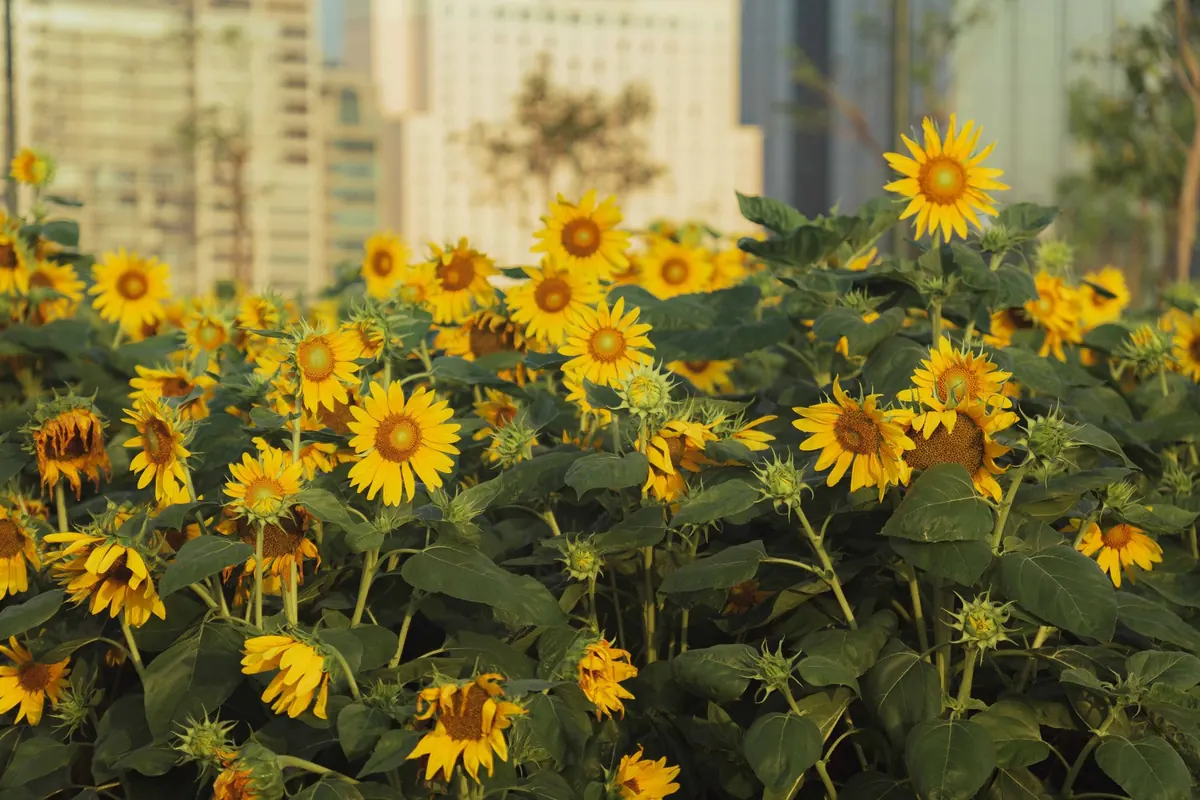
Branching varieties are grown for duration rather than for one grand moment. 'Autumn Beauty', 'Italian White', 'Lemon Queen' and the compact 'Cherry Rose' produce a central head first, then a succession of side shoots, each carrying a smaller flower. In a mild site that means color from midsummer into October, and a steady supply for the kitchen table. Newer types such as 'Sunfinity' have been selected to keep branching without being pinched at all.
Pinching is still the classic trick. When a branching plant is about 30cm tall with four to six true leaves, pinch out the growing tip between finger and thumb. The plant responds with more stems, more flowers and a slightly later start — usually a week or two. For a long late-summer display that trade is almost always worth it.
These are the cut-flower sunflowers. Cut stems in the morning, when the head is just opening, strip the lower leaves and stand them in deep, cool water for a few hours before arranging. The stems bleed a milky sap that shortens vase life; dipping the cut ends in just-boiled water for twenty seconds before conditioning helps, as does changing the water every other day. Give branching types 45–60cm of space so air moves between the stems and mildew stays away.
Sunflowers are fast, and that speed is what makes late-season planning possible. Most varieties flower roughly two to three months after sowing. A first sowing around the last frost gives flowers in July; a second, three or four weeks later, carries the display into August and September. In mild climates a midsummer sowing extends color toward the first frost, though those plants will be shorter and slower to establish than spring-sown ones.
Give sunflowers full sun — six hours or more — and lean soil rather than rich. Too much nitrogen produces tall, leafy plants with soft stems and fewer flowers, which is the opposite of what a windy site needs. Watch for slugs and snails while seedlings are small, and expect birds and squirrels to notice the seed heads in autumn; if you want the seeds for yourself, tie a paper bag over a few heads as the backs turn brown and leave the rest for the wildlife.
Then decide what you actually want from the last third of the season: one towering flower to mark the end of summer, a pot by the door that keeps its face at eye level, or a row of branching stems still flowering when everything else has finished. Three habits, three different jobs. Choose the one that fits the space, and the color will look after itself.
Photo: Theodore Nguyen / Pexels